.png?width=600&height=100&name=White%20NEW%20logo%20Email%20Header%20-%20standard%20(2).png)
RECON Client Meetings: The Proven Framework to Keep and Grow Your Best Accounts
If you're a salesperson who has ever lost a client you thought was solid, this is for you.
Not because they had a bad experience. Not because a competitor swooped in with a lower price. But because no one was paying attention. No one was asking the right questions. And by the time renewal came around, the relationship had quietly gone cold.
RECON client meetings fix that. They give you a structured, repeatable way to stay inside your best accounts—protecting the revenue you've already earned while systematically uncovering the next deal hiding in plain sight.
What Is a RECON Client Meeting?
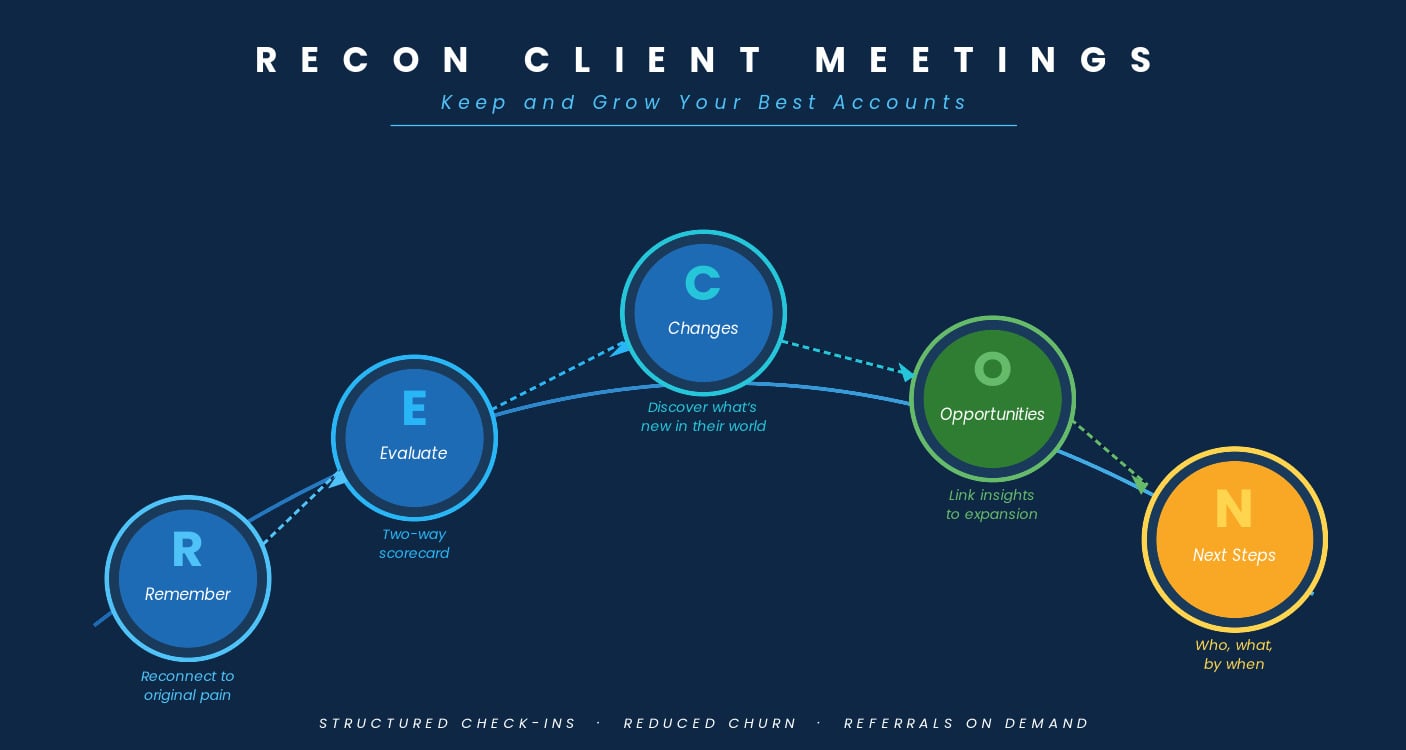
A RECON client meeting is a structured check-in with an existing customer designed to do three things at once: reduce churn, deepen the relationship, and surface new opportunities.
The word RECON is an acronym:
- R — Remember
- E — Evaluate
- C — Changes
- O — Opportunities
- N — Next steps
- A Accounts — Monthly. These are your highest-value clients. Frequency signals that you treat them like the priority they are.
- B Accounts — Quarterly. Enough contact to stay relevant and catch issues before they escalate.
- C Accounts — Twice per year. Minimum viable relationship maintenance.
- Team changes — new hires, departures, promotions, restructuring
- Strategic shifts — new markets, new products, pivots, cost-cutting initiatives
- External pressures — competitive dynamics, regulatory changes, economic headwinds
- Leadership changes — a new VP of Sales, a new CEO, a new board mandate
- Who is doing what
- By when
- When you’ll meet again
- Review account history, last conversation notes, and any usage or results data
- Prepare two or three specific conversation starters based on what’s changed since you last spoke
- Send a written recap within 24 hours
- Log the outcome and schedule the next touchpoint immediately
Unlike a casual “just checking in” call—which most clients see through immediately—RECON gives every conversation a clear purpose and a predictable arc. You walk in with an agenda. You walk out with action items. Your client walks away feeling like a priority, not an afterthought.
Why Most Sales Teams Lose Accounts They Should Have Kept
Here’s the uncomfortable truth about churn: most of it is preventable.
Clients don’t usually leave because your product failed them. They leave because they stopped feeling like you cared. The onboarding excitement fades, the relationship gets handed to a junior rep, and the only time they hear from you is when it’s time to renew—at which point they’ve already been talking to your competitor for three months.
Waiting until renewal to have a meaningful conversation is too late. By then, the client has mentally checked out. They’ve already made a decision. You’re just negotiating the exit.
RECON meetings interrupt that pattern. They keep the relationship warm and the communication honest throughout the entire customer lifecycle—not just at the beginning and the end.
How Often Should You Run RECON Meetings?
The right cadence depends on the value and strategic importance of each account. A simple tiering system works well:
One facilitator who implemented this cadence reported keeping 10 out of 12 planned touchpoints with A accounts over the course of a year—and saw a measurable drop in preventable churn within two quarters. That’s not a coincidence. Consistent contact creates consistent trust.
If you manage 20 accounts right now, ask yourself honestly: how many of them would say you reached out proactively in the last 90 days? If the answer makes you uncomfortable, start there.
How to Run a RECON Meeting: A Step-by-Step Breakdown
R — Remember: Reconnect to Why They Started
Begin every RECON meeting by reconnecting the client to their original reason for working with you.
This isn’t nostalgia. It’s strategic. Clients forget. They get busy, internal priorities shift, and the problem that felt urgent 18 months ago gets buried under the next crisis. Your job is to remind them—specifically—what they were trying to solve when they first hired you, and how far they’ve come since then.
A simple opener sounds like this:
|
“When we first started working together, you mentioned that your team was struggling to run effective discovery calls and that it was costing you deals in the final stages. Over the last quarter, we’ve focused on call frameworks and coaching cadences. How is that playing out for you now?” |
This accomplishes three things immediately. It shows you were listening. It anchors the conversation in business outcomes, not features. And it gives the client a concrete before-and-after reference point—which makes the value of your work tangible rather than abstract.
E — Evaluate: Ask for the Honest Review
After Remember, invite a two-way evaluation. This is where most salespeople get squeamish—because it opens the door to criticism. That discomfort is exactly why you should do it.
Ask your client to rate how things are going. What’s working? What isn’t? Where do they feel like you’re delivering, and where do they wish the experience were different?
Then ask how you are doing as a partner—not just your company, not just the product, but you personally. Are you responsive? Are you adding value between meetings? Do they feel like you understand their business?
This level of candor is rare, and clients notice it. One sales trainer reported maintaining relationships with clients investing $50,000 per month for years—not because nothing ever went wrong, but because RECON meetings created a safe, recurring space to surface friction and fix it before it became a reason to leave.
C — Changes: What’s New in Their World?
After the evaluation, pivot to discovery. What has changed since you last spoke? Ask about:
Then share what’s changed on your side. A new tool, a new service offering, a new case study from a client in their industry. Reciprocal transparency deepens trust and positions you as someone who thinks about them between meetings, not just during them.
Changes are where expansion revenue hides. A new regional office needs onboarding. A new sales leader needs to be enrolled in your program. A new product line needs a different conversation framework. You won’t find any of that if you’re not asking.
O — Opportunities: Connect What You Heard to What You Can Do
This is where RECON shifts from relationship maintenance to revenue generation.
Take everything you learned in the Changes conversation and connect it explicitly to what you offer. Don’t wait for the client to connect the dots. That’s your job.
|
“You mentioned you’re bringing on a new sales director next quarter. We have a leadership onboarding track that gets new managers up to speed on your methodology in four weeks instead of four months—would it make sense to talk about that?” |
You’re not pitching. You’re problem-solving out loud, using information the client just gave you. That’s a very different conversation, and clients feel the difference.
N — Next Steps: Close Every Meeting with Clarity
Never leave a RECON meeting without confirming exactly what happens next. Specify:
Vague endings kill momentum. A meeting that ends with “let’s stay in touch” is a meeting that accomplished nothing.
|
“I’ll send you a one-page summary of the results we reviewed today by Thursday. You’ll forward the boot camp proposal to Marcus by end of next week. And we’ll meet again on the 18th at 10 a.m.—same format as today. Does that work?” |
Get it in writing. Send a recap within 24 hours. Show up prepared.
How to Ask for Referrals Inside a RECON Meeting
Research in sales training consistently shows that approximately 85% of satisfied customers would be willing to refer their provider to someone they know. Yet only about 12% of salespeople ever ask.
That gap represents an enormous amount of revenue that simply never gets generated—not because clients are unwilling, but because salespeople are uncomfortable making the ask.
RECON meetings are the ideal place to close that gap. You’ve just spent 30–45 minutes talking about results. The client is in a positive, forward-looking frame of mind. The relationship is warm. The evidence of value is fresh in the room.
Avoid the generic: “Do you know anyone who might be interested in what we do?” That question puts the entire burden of thinking on the client. Instead, make it specific and low-friction:
|
“Most of my new clients come from introductions made by people I already work with. Based on what you shared today about [specific result], I’d love to meet two or three people who work in similar roles or are facing similar challenges. Would you feel comfortable sending a short email introducing us and copying me?” |
Before the meeting ends, confirm a specific date by which they’ll send the introduction. Not “I’ll try to do it this week”—but “I’ll send it by Wednesday.” That accountability step is the difference between a referral that happens and one that gets forgotten.
The Business Case for RECON: Revenue Retention Is Revenue Growth
Customer acquisition typically costs five to seven times more than customer retention. Every account you keep is a deal you didn’t have to go find, negotiate, or close from scratch.
RECON meetings make retention systematic. They replace hope (“I think we’re in good shape with that account”) with evidence (“I talked to them last month, I know exactly where we stand, and here’s what we’re expanding into next quarter”).
For salespeople managing a book of business, that shift—from reactive to proactive, from assumptive to evidence-based—is what separates account managers who defend revenue from those who grow it.
If you currently have 15 active accounts and no formal check-in cadence, start with your top five. Schedule one RECON meeting per account this month. Use the framework. Take notes. Show up next time with a recap of what you discussed and a plan for what’s next.
RECON Meeting Quick Reference
Before the meeting:
During the meeting:
|
Stage |
Key Question |
|
Remember |
When we started working together, you told me [X]. How has that evolved? |
|
Evaluate |
On a scale of 1–10, how would you rate the value you’re getting? What would make it a 10? |
|
Changes |
What’s shifted in your business since we last spoke? |
|
Opportunities |
Given what you just shared, here’s something that might be worth exploring… |
|
Next Steps |
Let’s confirm—who does what, by when, and when do we meet next? |
Referral ask (when results are positive):
|
“Most of my new clients come from introductions. Can you think of two or three people I should meet? Would you be comfortable sending a short email?” |
After the meeting:
Frequently Asked Questions
What makes RECON different from a regular account check-in?
A regular check-in has no structure and no clear purpose beyond touching base. RECON gives every meeting a defined agenda, a two-way review, an expansion conversation, and confirmed next steps. It transforms a courtesy call into a strategic business conversation.
How long should a RECON meeting take?
Most RECON meetings run 30–45 minutes when facilitated well. With very senior stakeholders or high-complexity accounts, allow up to an hour. Avoid letting them run long without capturing specific action items—length without structure is a waste of everyone’s time.
What if the client gives negative feedback during Evaluate?
That’s the goal. Negative feedback surfaced in a RECON meeting is recoverable. Negative feedback shared with a competitor after a client has already decided to leave is not. Thank them for the honesty, confirm that you heard them correctly, and commit to a specific action with a specific timeline. Then deliver on it.
Should RECON meetings happen in person or remotely?
Either format works. What matters is preparation and follow-through, not format. That said, A accounts warrant in-person meetings whenever geography allows—the signal value of showing up matters.
When should you ask for referrals in a RECON meeting?
At the end, after the Evaluate stage has produced positive feedback. Never ask cold, and never ask before you’ve established the value in that specific conversation. The referral ask should feel like a natural extension of the results you just discussed together.
RECON is not a complicated system. It’s a disciplined one. The salespeople who use it consistently don’t just retain more accounts—they grow them. They ask better questions. They hear things their competitors miss. And they turn every satisfied client into a source of warm introductions.
The framework is simple. The discipline is the differentiator. Start your first RECON meeting this week.