.png?width=600&height=100&name=White%20NEW%20logo%20Email%20Header%20-%20standard%20(2).png)
Sales Cookbooks: Turn Goals into Daily Winning Habits
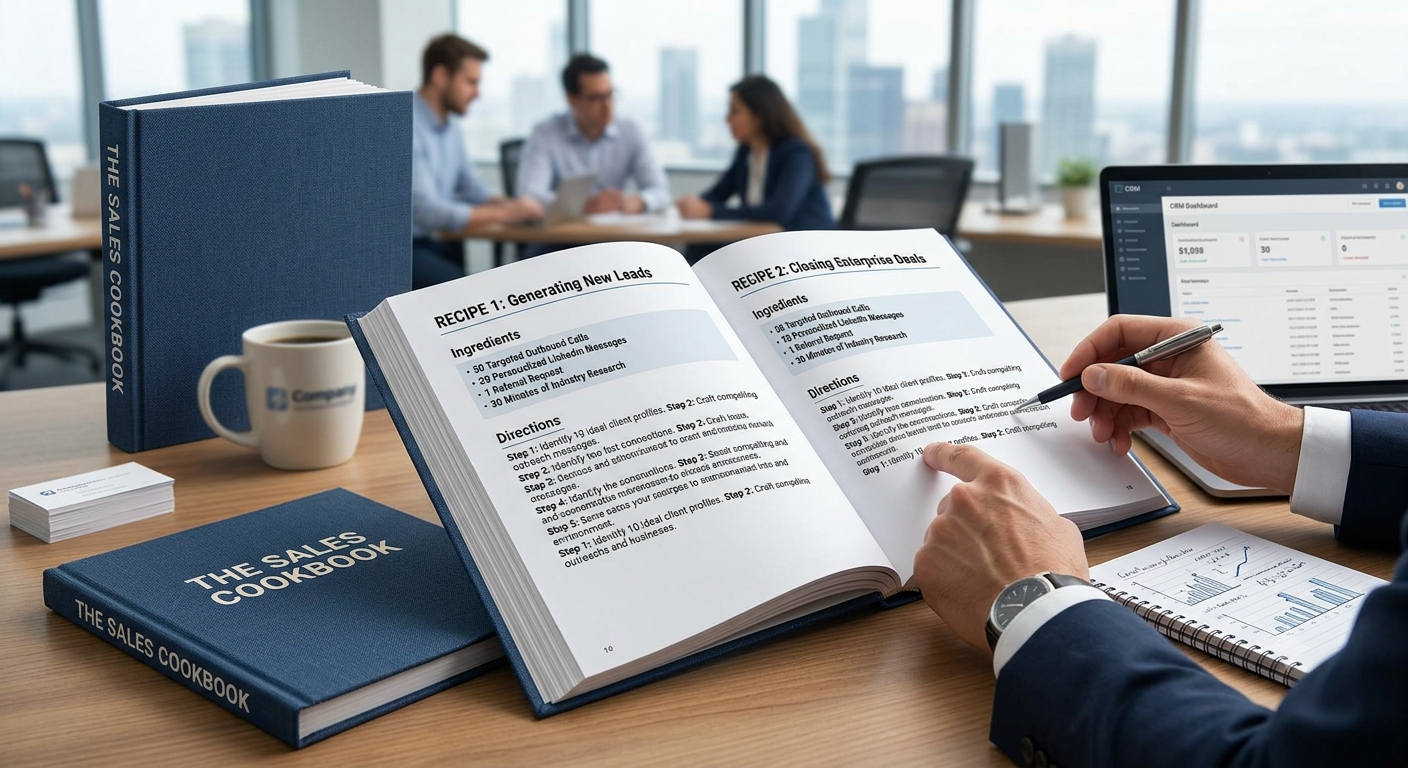
For most sales professionals and sales managers, traditional selling feels inherently chaotic. Revenue is unpredictable, pipeline forecasts fluctuate wildly, and quarter-end rushes create unnecessary stress.
This instability happens because revenue is a lagging indicator. By the time you miss your quarterly quota, it is too late to fix the problem.
To build a predictable sales pipeline, high-performing sales organizations rely on a sales cookbook. A sales cookbook translates abstract revenue targets into a controllable, activity-based recipe for daily and weekly behavior.
What Is a Sales Cookbook?
A sales cookbook is an operational, activity-based management system that converts high-level sales quotas into specific, repeatable daily and weekly behaviors (dials, LinkedIn touches, discovery calls, referral asks).
Definition: A Sales Cookbook is a structured sales performance framework that reverse-engineers a target revenue goal into necessary top-of-funnel activities based on historical funnel conversion ratios.
Popularized by sales methodologies like the Sandler Selling System, the cookbook model shifts a seller’s focus from outcomes they cannot directly control (revenue) to inputs they completely control (activities).
Sales Cookbook vs. Sales Playbook
While often confused, a sales cookbook and a sales playbook serve entirely different functions in a revenue engine:
| Feature | Sales Cookbook | Sales Playbook |
| Primary Focus | Volume, frequency, and behavioral discipline | Messaging, strategy, and execution technique |
| Core Question | "What specific actions must I complete today?" | "How do I win this specific deal or handle this objection?" |
| Key Output | Daily execution metrics (e.g., 20 calls, 2 meetings) | Battlecards, objection scripts, buyer personas |
| Primary Metric | Activity volume and stage-to-stage conversion rates | Win rate, average deal size, sales velocity |
How to Build a Sales Cookbook in 5 Steps
Creating an actionable sales cookbook requires reverse-engineering your annual revenue quota through your historical funnel data.
[Annual Revenue Target] ↓ [Closed-Won Deals Required] ↓ [Proposals / Demos Needed] ↓ [Discovery Meetings Scheduled] ↓ [Daily & Weekly Activity Ratios] Step 1: Establish Your Net Revenue Target
Identify your annual new-business revenue goal. Subtract recurring revenue or predictable renewals to find your Net-New Target.
- Example Target: $1,200,000
Step 2: Determine Average Contract Value (ACV)
Divide your target revenue by your average deal size to calculate total closed-won deals needed per year.
- Example ACV: $50,000
- Calculation: $1,200,000 /$50,000 =24 closed deals/year (2 deals/month).
Step 3: Calculate Funnel Conversion Ratios
Audit your last 6 to 12 months of CRM data to establish stage-to-stage conversion efficiency:
- Proposal-to-Close Rate: 25% (4 proposals needed per 1 deal)
- Meeting-to-Proposal Rate: 40% (2.5 meetings needed per 1 proposal)
- Conversation-to-Meeting Rate: 25% (4 conversations needed per 1 meeting)
Step 4: Work Backward to Monthly & Weekly Activity Levels
Multiply your deal requirement backward through your conversion rates:
- Deals Needed: 2 per month
- Proposals Needed: 2/0.25 = 8 proposals/month
- Meetings Needed: 8 /0.40 =20 qualified meetings/month
- Conversations Needed: 20/0.25 =80 live conversations/month
Step 5: Establish Daily & Weekly Execution Targets
Divide your monthly metrics across 4 weeks per month (or 47 working weeks per year) to create daily targets. Assuming a 10% connect rate on cold calls (200 dials for 20 live conversations):
Sample Sales Cookbook Targets (47 Working Weeks)
- Weekly Metrics:
- 100 Outbound phone calls
- 40 Personalized LinkedIn touchpoints
- 5 Client referral conversations
- 10 First-time discovery meetings set
- Daily Metrics:
- 20 Outbound phone calls
- 8 LinkedIn outreach messages
- 1 Client referral ask
- 2 Discovery meetings booked
Best Practices for Sales Reps and Managers
For Individual Sellers: Managing the Recipe
- Time Block Prospecting: Schedule two non-negotiable 90-minute blocks daily dedicated strictly to top-of-funnel cookbook activities (calls, emails, LinkedIn).
- Track Leading Indicators Daily: Log activities immediately upon completion. Do not wait until Friday afternoon to guess your weekly output.
- Audit Ratios Quarterly: As your sales skills improve, your conversion rates will increase. Higher conversion efficiency means fewer top-of-funnel activities are required to hit quota.
For Sales Managers: Coaching with the Cookbook
- Diagnose Skill Gaps: Use conversion ratios to pinpoint exact performance breakdowns. If a rep achieves their meeting activity target but generates zero proposals, coach them on discovery and qualification techniques rather than telling them to make more calls.
- Eliminate Micromanagement: The cookbook gives sellers autonomy. When reps hit their weekly activity metrics, managers can trust the process without hovering.
- Personalize Recipes: Adjust cookbooks based on rep tenure and skill level. A veteran AE with a strong referral network requires a different recipe than an SDR initiating cold outreach.
Frequently Asked Questions (FAQ)
What is the primary difference between a sales cookbook and a sales quota?
A sales quota is a financial target expressed in dollars (a lagging indicator). A sales cookbook is the specific formula of daily and weekly behaviors required to achieve that dollar target (leading indicators).
Why is a sales cookbook important for sales teams?
A sales cookbook removes guesswork from hitting revenue goals. By breaking a large annual quota down into controllable daily actions, sellers eliminate pipeline anxiety, maintain consistent activity, and avoid end-of-quarter panic.
How often should a sales cookbook be updated?
A sales cookbook should be audited quarterly. Shifts in market demand, product pricing, target audience, or individual rep conversion skill directly impact the activity volume required to maintain revenue targets.
Does a sales cookbook replace a sales playbook?
No. A sales cookbook dictates activity volume and behavior (what to do and how often), while a sales playbook dictates sales strategy and technique (how to conduct calls, handle objections, and position solutions). Both are required for a scalable revenue system.
Revenue isn't a matter of luck, talent, or last-minute quarter-end heroics—it is a matter of mathematical consistency. When you replace chaos with a structured sales cookbook, you shift from hoping you'll hit quota to knowing exactly when and how you'll reach it.
Stop guessing what your week should look like. Reverse-engineer your annual quota today, write down your 4 to 6 core daily behaviors, and build a pipeline that is predictable, scalable, and entirely within your control.