.png?width=600&height=100&name=White%20NEW%20logo%20Email%20Header%20-%20standard%20(2).png)
The Art of the 10-Second Intro (And How to Move to a Meeting)
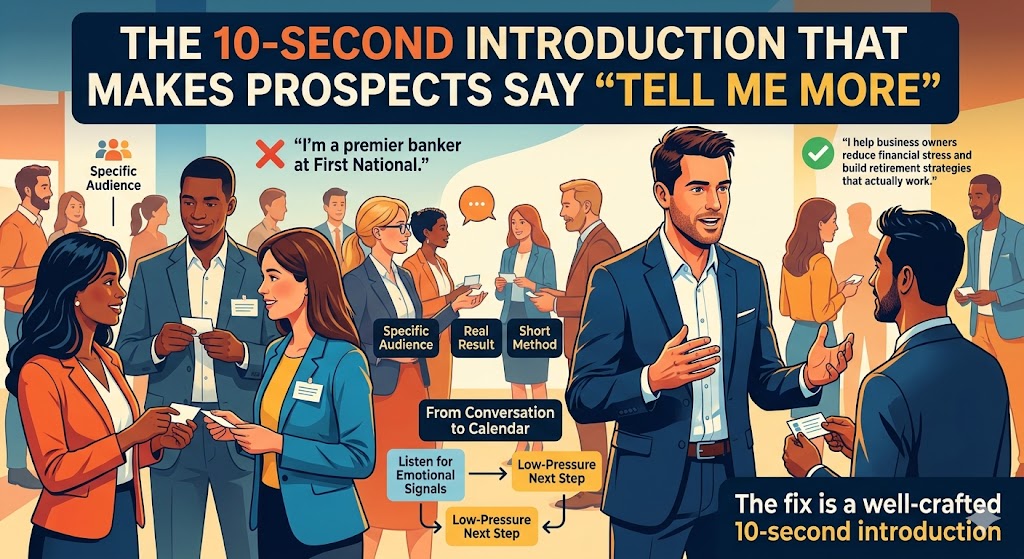
If you've ever introduced yourself at a networking event and watched someone's eyes glaze over, you already know the problem. Most salespeople lead with their job title, their company name, or a paragraph of backstory. None of that creates curiosity. None of it earns a next conversation.
The fix is a well-crafted 10-second introduction and it's one of the highest-leverage skills any salesperson can develop.
What Is a 10-Second Sales Introduction?
A 10-second introduction is a single, clear sentence that answers one question in the listener's mind: Why should I care?
It is not your title. It is not your company's tagline. It is not a mission statement.
It follows a simple structure:
"I help [specific audience] [achieve a meaningful result] by [brief method]."
Compare these two versions:
- ❌ "I'm a premier banker at First National."
- ✅ "I help business owners reduce financial stress and build retirement strategies that actually work."
The second version speaks to an emotional outcome — financial stress is real, it's felt, and it immediately prompts the follow-up question: "How do you do that?" That's exactly the response you want.
The goal of your 10-second intro isn't to close a sale. It's to open a door.
How to Build a 10-Second Intro That Sparks Real Conversations
Step 1: Name a Specific Audience
Vague audiences produce vague interest. "Anyone who needs advertising" doesn't make anyone lean in. "Dental practices," "local home service companies," or "e-commerce founders under $5M revenue" do.
Specificity signals expertise. It also makes the right people self-identify — and the wrong ones quietly opt out, saving you both time.
Step 2: Lead With a Real Result — Not a Process
Results that resonate describe a problem eliminated or a gain achieved:
- "Stop losing opportunities they don't even know they're missing"
- "Grow revenue without adding headcount"
- "Build retirement security on their timeline"
Results that don't resonate describe what you do mechanically:
- "Optimize marketing performance"
- "Provide strategic financial guidance"
- "Leverage data-driven insights"
If your listener couldn't repeat your line to a colleague an hour later, simplify it.
Step 3: Add a Short Method Reference (Optional)
You can close your sentence with a brief nod to how — "using results-based advertising" or "with a proven retirement planning process" — but keep it short. The deeper explanation belongs in the conversation that follows, not in your first sentence.
Step 4: Test It Out Loud
Say your intro to a trusted colleague. If they respond with "Tell me more" or "That sounds like me," you're on the right track. If they say "So… what do you actually do?" — go back and simplify.
Aim for 10–15 seconds when you say it aloud. Time yourself.
Beyond Networking: Where Your 10-Second Intro Goes to Work
Your introduction isn't just for events. It becomes:
- The first sentence of a cold voicemail
- The opening line of a prospecting email
- Your answer when a referral asks, "What do you do?"
- Your LinkedIn headline, rewritten for clarity
Consistency here is the compounding advantage. When your value is simple and repeatable, busy decision-makers can remember it — and more importantly, pass it along.
From Conversation to Calendar: Moving Interest Into a Meeting
Once your intro sparks curiosity, the next move is qualifying that interest and locking in a next step — without being pushy. Here's a simple, Sandler-aligned sequence:
- Deliver your 10-second line.
- Ask one or two open questions about their world: "How are you currently handling that?" or "What's working and what isn't?"
- Listen for emotional signals — words like frustrated, concerned, overwhelmed, under pressure. These are pain indicators.
- Reflect what you heard: "It sounds like you're frustrated that leads are coming in but not converting — and you're not sure where the breakdown is."
- Ask a low-pressure next step: "Would it make sense to schedule a 20-minute call to see if we can help with that?"
This approach honors equal business stature — a core Sandler principle. You're not chasing or convincing. You're inviting a peer-level conversation between two professionals who might be able to help each other.
The goal at every networking event, every trade show booth, every chance hallway conversation is not to close. It's to create a clear, agreed-upon reason to talk again.
The Bottom Line
A strong 10-second introduction is not a gimmick. It's the first proof that you understand your buyer — that you speak their language, not yours. It's also trainable, testable, and improvable over time.