.png?width=600&height=100&name=White%20NEW%20logo%20Email%20Header%20-%20standard%20(2).png)
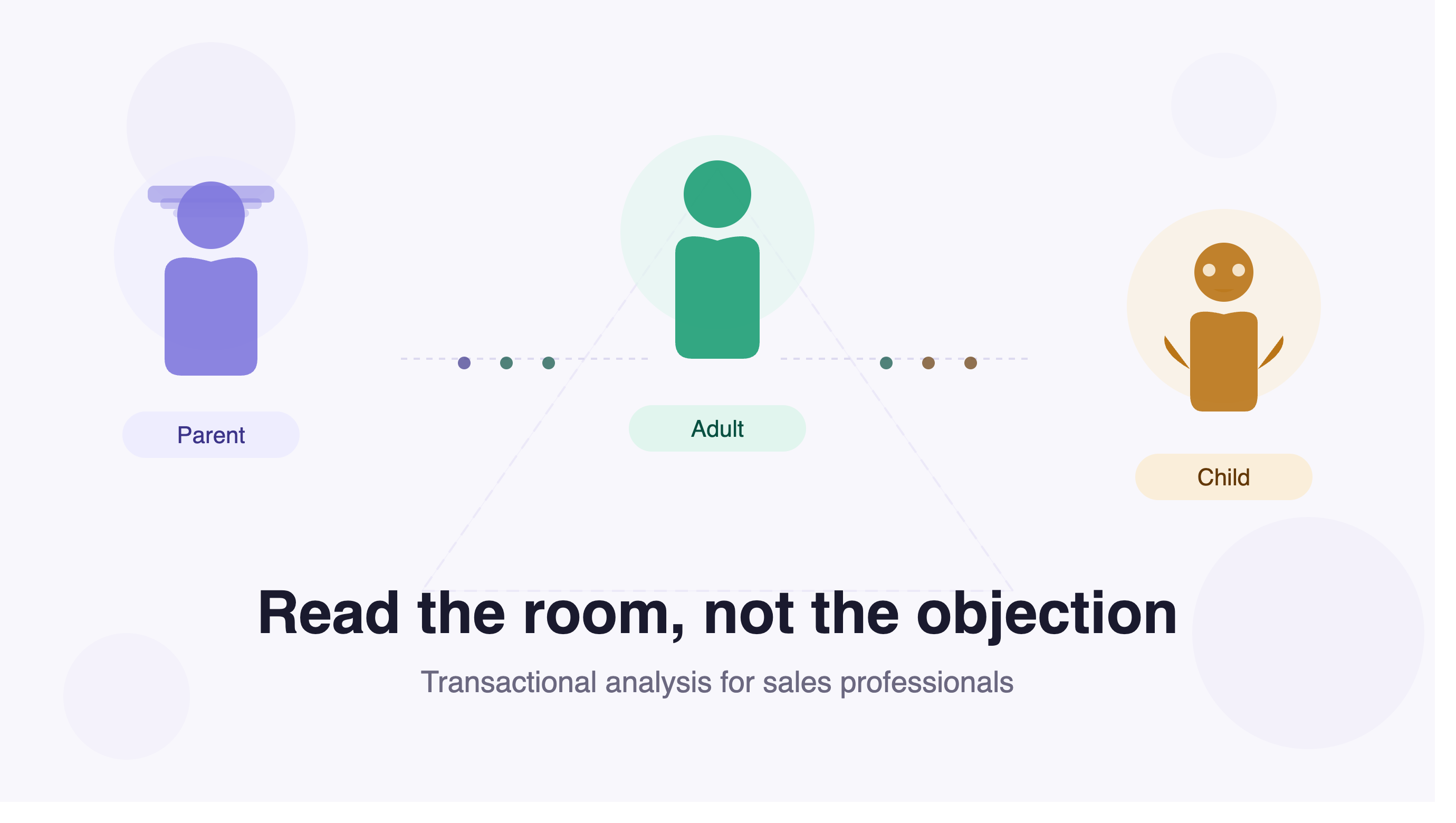
Read the room, not the room’s objections
Why deals stall has less to do with your product and more to do with what’s happening psychologically. Transactional Analysis gives you a map.
THE CORE FRAMEWORK
Three ego states, infinite deal outcomes
Every person in every conversation is speaking from one of three ego states. So are you. The state you’re each in — and whether they match — determines whether the conversation moves forward or sideways.
|
Parent CRITICAL "You should know this by now." Judgmental. Shuts conversations down. NURTURING "That sounds frustrating — let’s slow down." Your best opener. |
|
Child NATURAL "This could really help us." Open, curious. Where buyers decide to buy. REBELLIOUS "Your competitor is cheaper." Defensive. Classic price-objection mode. |
|
Adult ALWAYS "What outcomes do you need this quarter?" Calm, factual, present-focused. Aim to live here. |
Here’s the key insight: buyers decide in Child. The emotional part wants something fixed. Adult and Parent then justify and check risk. So your job is to wake up their Natural Child, then give their Adult the logic it needs to approve the decision.
|
THE PATTERN THAT WORKS Use problem and impact questions to stir Child → summarize the business case for Adult → address risk and fit for Parent. |
WATCH OUT FOR THIS
The drama triangle: a deal killer in three acts
When conversations get tense, people slip into three toxic roles. Recognizing which one you’re being pulled into is the first step to getting out.
|
Persecutor "You never get us what we need." You end up here when a deal drags and you blame the buyer for wasting your time. |
|
Victim "Procurement always blocks me." The buyer plays this role to get you to work around their internal problems for free. |
|
Rescuer "I’ll fix this for everyone." You slide here when you do unpaid consulting and extra proposals without commitment. |
The exit is Adult. Instead of rescuing, use equal-stature language that respects the buyer without taking over their job:
|
“I’m happy to explore that. Before we invest more resources — can we agree on who signs off and what decision will be made?” |
|
“It sounds like there’s real tension with procurement. What have you already tried internally, and what would a good outcome look like for you?” |
APPLY IT TO YOUR PROCESS
TA overlaid on a real sales conversation
|
Rapport |
Nurturing Parent → Child Create safety. Listen actively. “That sounds like a lot to manage” signals care without rescuing. |
|
Upfront contract |
Adult → Adult Agree on time, agenda, and possible outcomes upfront. Reduces surprise — the #1 trigger for Child-state reactions at the close. |
|
Pain exploration |
Nurturing Parent → Child Step gradually: “Can you give an example?” → “How does that affect your team?” → “What happens if nothing changes?” Skipping ahead triggers Protected Child — they shut down. |
|
Budget |
Adult → Adult Bridge from emotion to numbers: “You mentioned $400K in lost revenue. On a scale of 1–10, how committed are you to solving this?” Invites reflection, not excitement. |
|
Decision |
Adult → Adult “Who will be involved in the final review, and what criteria will they use?” Then link your demo back to their specific pains — Child still feels heard, Adult sees the logic. |
THIS WEEK
Four exercises that build the muscle
Post-call journal (10 min)
After 2–3 important calls: When did the energy shift? What ego state were you in before and after? What would you say next time to return to Adult?
Rewrite a tough email
Take a message where a buyer challenged your offer. Write version A from Critical Parent (“We already explained this”). Write version B from Adult + Nurturing Parent. Send B.
Drama triangle spot-check
In your next team meeting, ask: “Where am I at risk of playing Rescuer on this account?” Agree on one boundary or Adult-state question you’ll use instead.
Role-play the “price is too high” moment
Have a colleague go Critical Parent: "Your competitor is cheaper and better." Practice responding without defending: "Thank you for being direct. Would you walk me through what you’re comparing so we can see if there’s a fit?"
|
THE BOTTOM LINE The product hasn’t changed. Your presence has. That’s often the difference between a stalled opportunity and a clear, mutual decision. |